Arturo Peña
Fictional. Generated by AI — not a real person, and no likeness of one is intended.
62, nurse in Small-town Ohio · rolled by @colin.hasbrook · card — no film
History
who has worn him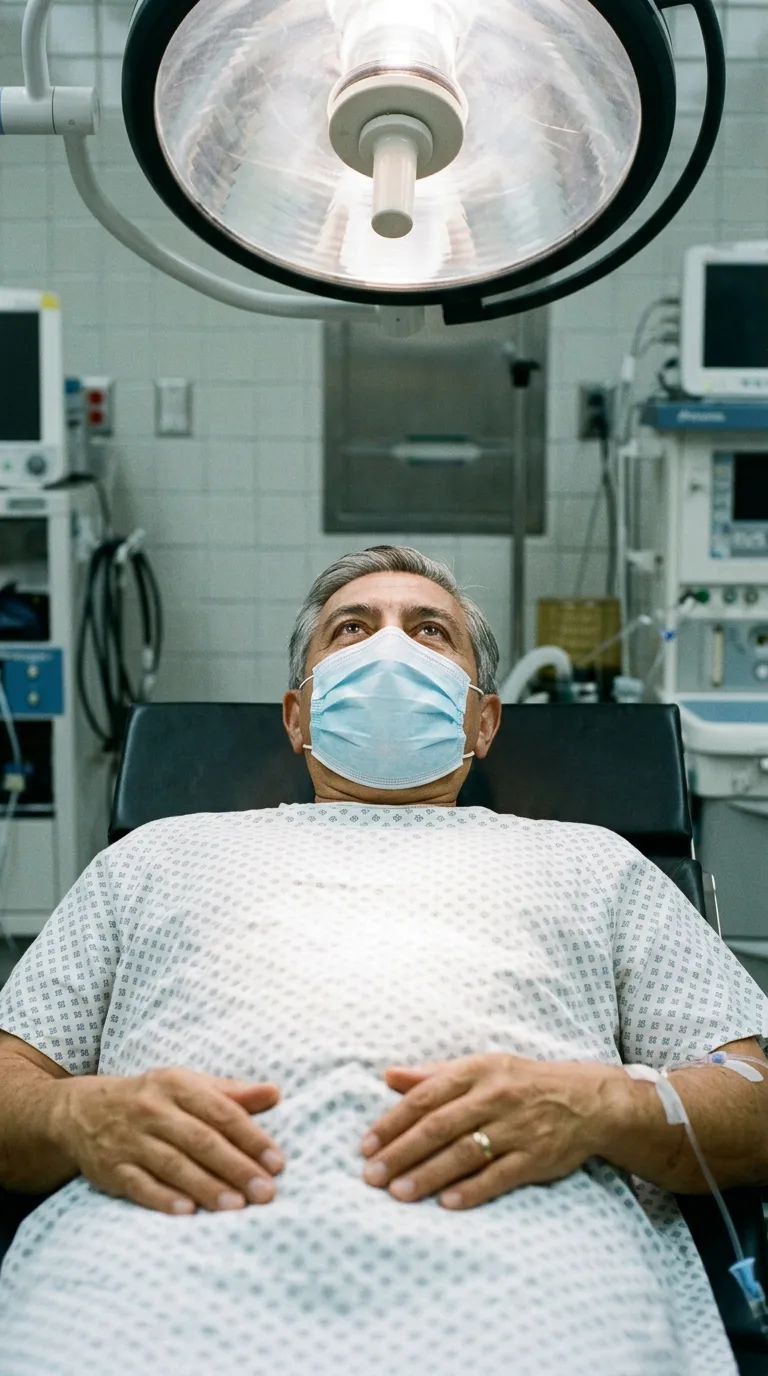
Rarest thing about him: An autoimmune condition — rare, 1 in 84
Season 0seed 699279798 · engine v10
Character card
lineage 2NZHHJ
His body-swap story
@colin.hasbrook, wearing Ryan Holt, rolled the wheel on and woke up as Arturo Peña, spent under a minute in him, then spun the wheel and woke up as Dominique Fairweather
---
The office window frames the harbor in the flat gold light of a Friday that Ryan Holt earned and you did not. His phone is face-down on the desk beside a mug that says WORLD'S OKAYEST MANAGER, a joke gift from a subordinate who does not know it is accurate. The scar through his eyebrow itches the way it always does when the trade winds shift. You have been him for four months, and for four months the itch has been the most interesting thing about him.
He is thirty-four, athletic, blue-eyed, and utterly without friction — a man whose life runs so smoothly you have started to resent the maintenance. Meetings that go fine. A girlfriend who is fine. A gym routine that keeps the shoulders fine. You spun four hundred and ninety-nine times looking for something with edges, and Ryan Holt turned out to be sanded down on every side. There is a specific despair in a body that nothing is wrong with. You open the site on his phone with his thumbprint, because his thumbprint is yours now, and the wheel spins, indifferent to whose hand set it going.
—
The light above you is the kind that makes everything underneath it look already embalmed, and the mask over your mouth smells like clean plastic and someone else's toothpaste. A voice is counting — five, six — and on seven it simply stops being your voice to notice, and the number falls into a mouth that is not moving anymore because it is not yours to move. Then it is. Under closed lids the eyes drag once, left to right, cataloguing dark. The hand on the table — heavier than any hand you've wanted, the knuckles thick, a ring pressing cold against a finger it has worn for decades — opens. Closes. Opens again. Testing.
The monitors don't startle. Whatever this is registers to them as sleep.
—
The gown against your back is thin, hospital cotton, and it gives you nothing — it isn't his, it's borrowed for the hour — but the ring is. The ring has thirty-one years in it, and it comes through your finger like heat finding a hand held too near a stove: Marisol in a yellow dress on a courthouse step in Toledo, laughing at something his mother said in Spanish that the JP didn't understand, and neither of them translating it for him on purpose. That's the first flash, gone before you can hold the whole shape of it, only the warmth left behind like a coal under ash.
Then the IV line tugs faintly at the back of your other hand, and that pulls something too — not memory exactly, more like weather: the ache that lives in his joints most mornings now, low-grade, familiar as a dog that sleeps at the foot of the bed, an autoimmune thing his rheumatologist has a name for that he never quite remembers correctly when his daughter asks. Sara asks. The name arrives with her name — Sara, twenty-six, works too many hours at a firm in Columbus and calls every Sunday at six because she used to call every Sunday at six when she was homesick freshman year and neither of them ever renegotiated the schedule. And a son — Danny — thirty, quieter, lives forty minutes away and shows up unannounced with beer and says nothing about anything that matters, which is its own kind of closeness if you've learned to read it, and Arturo has, thirty years of night shifts teach you to read silence as data.
The mask still cups your face, and under it his jaw is already doing what it does without him — clenching, a muscle standing up along the hinge of it, a habit older than the marriage. You feel the whole architecture of that jaw: not handsome exactly, not once was, but reliable-looking, a face patients trust with their worst nights, and worth trusting, because underneath the clench there really is someone paying attention.
The gown falls open a little at the shoulder and gives you skin — sixty-two years of it, looser than Ryan's, spotted faintly at the forearm, but the muscle underneath still real, still work-built: two decades of turning patients, hauling crash carts, holding a line steady while someone screamed. Strong in the specific way that has nothing to do with mirrors. And under that, ropes of old fatigue — feet that ache by hour six of any shift, a lower back that has opinions about long codes, the particular exhaustion of a man who has held other people's dying so many times that his own eventual dying feels almost like professional courtesy.
You are not touching his scrub top now, but it comes anyway, close enough — the memory of this morning arrives sideways, borrowed from the IV tape at your wrist, from the whole ritual his body has run ten thousand times: the navy top over his head at 6:40 a.m. in a bathroom in a small Ohio house, wife still asleep, porch light left on out of habit though the diner across the street closed for good in March and there's no one left to see it. Sleeve by sleeve, unhurried, the same v-neck he's owned four of for eleven years, the badge reel clipped to the pocket with a practiced flick of the thumb, no mirror-check because he stopped needing one around fifty. He'd made coffee he didn't drink because Marisol likes the smell of it when she wakes. He'd stood in the driveway a second longer than necessary, looking at the stoplight two blocks down turn from red to green to red for nobody, and felt, not for the first time, a kind of fondness for how small his life had gotten, and how little that seemed to matter next to the fact that it was his.
None of that explains why he is here now, gowned, gray-lit, a patient instead of the one charting at 2 a.m. under fluorescent light — some appointment scheduled around his own shifts, something routine he mentioned to Marisol without alarming her, something his own hospital colleagues are handling two floors from where he'd usually be standing. It is his own small mortality, arrived at sideways, the way most people's does.
—
Your hand — his hand — lies on top of the sheet, and you lift it into what light there is and open the fingers all the way, then close them, slower than before, watching the tendons stand and settle like something you're field-testing for the first time. The wedding band catches the surgical lamp and throws a thin coin of light across the ceiling tile.
You look up into the lens of the little wall-mounted monitor across the room, though nobody's watching it, and say, mouth still dry from the mask:
"There you are."