Arturo Miramontes
Fictional. Generated by AI — not a real person, and no likeness of one is intended.
44, bus driver in Rural Texas · rolled by @justin.moy · card — no film
History
who has worn him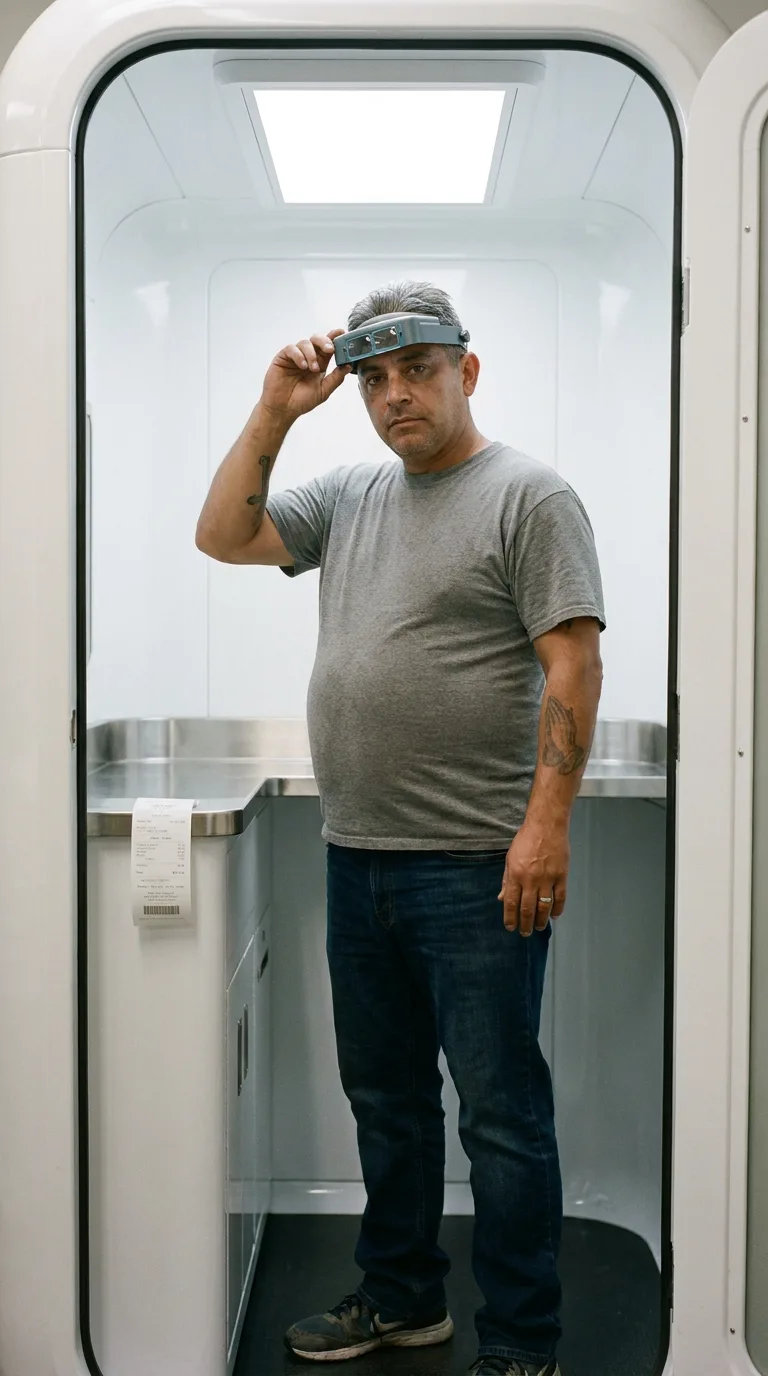
Rarest thing about him: A few, scattered — rare, 1 in 13
Legacyseed 1721054818 · engine v8
Character card
His body-swap story
---
You paid on a Tuesday, from a chair, with a card that isn't in his wallet and never will be again.
The screen showed you very little. That was the point of the price. No history, no photographs of the kitchen, no wife's name — just the specs, the way a listing gives you the mileage and not the road. Age forty-four. Five foot nine. Hazel. Latino. Rural Texas. Occupation: transit operator, route driver. Assets: nothing. That last line is what you clicked. Nothing to his name means nothing to unwind, nobody's lawyer, no accountant noticing a stranger's habits in a checking account. A man with nothing is a clean doorway.
You never met him. You want that understood, if only by yourself. He is a stranger. You did not choose him for revenge or love or any of the reasons that make a story. You chose him because the listing was cheap and permanent and because you were tired in a way that had stopped responding to sleep.
---
Now the visor comes up off his face and the light in the pod is the white of an empty page.
It lifts and your eyes are what's under it. That's the first thing — not a fall, not a rush, nothing cinematic. The visor rises the way a car hood rises and behind it there's a room you're already in. His hand is still on the frame of the thing. Your hand. It comes down slowly because you don't yet know how heavy his forearm is, and it is heavier than yours was, thicker at the wrist, and the tattoo on it swims into your lower vision — a cross, faded blue-green, the ink spread the way old ink spreads. On the other arm, praying hands. You feel nothing about them. He apparently did once. You've bought a body that has been to church and you don't intend to take it back.
You inventory. You can't help it; you've been waiting weeks. Belly, soft and low, pushing the gray t-shirt out. A back that has been sitting down for twenty years and says so. Knees that are fine. Lungs that are — you test them, a long pull of the clinic's cold nothing air — lungs that were smoked in and then weren't, for long enough that they've mostly forgiven him. Hair: he dyed it. You can feel the dye in it, that stiff flat quality, and you know without a mirror that the temples are gray and the roots are gray and that somebody, every five or six weeks, stood in a bathroom with a box and a comb and did this to himself in secret. That's a man who cared what he looked like getting on the bus in the morning. You're going to have to keep doing it or explain why you stopped.
An attendant's hand comes into the edge of your sight. Gloved. Holding a receipt, the thermal kind, curling already at one corner.
You take it. The fingers work. The wedding band on the left hand catches on the paper and you feel it — not tight, but present, the way a thing you've worn for years is present.
You read it.
You read it again.
Because the name on it is yours. Your legal name, printed small under TRANSACTION — CUSTOMER, and the total, and TERM: PERPETUAL, and a barcode. The renter's name, on a slip of paper, in the renter's hands, and there is nobody else left in the pod to be the renter. Whatever it cost you, that's the number. Whatever you are now, that's the name for it. The paper is warm from the printer. Your name looks like a stranger's name in this font. It looks like something you'd find in a dead man's pocket.
Somewhere behind your eyes there is no one to tell about this.
That's the part they don't put on the screen. Not that he screams — he doesn't, there's nothing to scream with, he's not in here shouting, there's no second voice, no passenger, nothing. Just quiet. Absolute vacancy, and you, standing in it, holding a receipt with your own name on it like a coat check ticket for a coat that no longer exists.
His right leg starts bouncing.
You didn't do that. That's the strangest thing that has happened to you in your whole life including this. The heel comes up and taps, up and taps, fast, a nervous engine idling in the muscle, and you have to consciously reach down into the thigh and stop it, and the second your attention moves it starts again. It isn't him. He's gone. It's the body's own leftover — a habit worn so deep into the wiring that it's furniture now, like a house that creaks in the same place after the family moves out. You will live with that leg for the rest of your life. You'll be in his kitchen with his wife across the table and the leg will be going and she'll reach over and put her hand on his knee without looking up from her phone, the way she has ten thousand times, and you will have to not flinch.
You fold the receipt. You put it in the jeans pocket. There's a receipt slot in your new head too, and you start going through it: not memories — you get no memories, that's not what this is — but the shape of what's owed. A route number you'll have to learn from the paperwork in his truck. A wife you'll have to be married to. Two kids, adults or near it, who will call and hear their father's exact voice come out of a stranger's mouth and never know. An ex-wife who apparently still matters, who will read something in this face across a parking lot and not be able to say what.
You've bought a man's whole life for less than a used car, and none of it is furnished. It's all standing there waiting, and the only tool you have is a mouth that already knows how to make his sounds.
---
The gravel road, when you find it, is the color of dust and goes on. Barbed wire on both sides, four strands, staples rusted. A water tower sits on the horizon with a town's name on it that you will learn to say the local way. There's a driveway with a cattle guard and a house at the end of it with a porch light on in the afternoon because somebody left it on last night and nobody's noticed yet.
You sit in his truck at the end of the driveway for eleven minutes.
You could go anywhere. That's the thing nobody understands about buying it for good: there's no term, so there's no reason to go home. You have a body with a valid CDL and no assets and no one looking for it. You could point it at Oklahoma.
But there's a porch light on, and there is a woman in there who thinks the only thing wrong with her afternoon is that her husband is late.
You drive up. The leg is going. You put your hand on your knee like you've seen men do.
---
It's a month later that you understand what you actually bought.
It's the end of a route. Last stop, town side, engine ticking. Empty seats behind you in two long rows, that green vinyl, the low late sun coming in flat through the windshield so everything in the cab is orange and you can see every scratch in the glass. You've got both hands on the big flat wheel. You've learned the air brake, the mirrors, the fourteen kids who get on at the county road and the one who doesn't talk. You are good at this. It surprises you how good, how the body knew the wheel's diameter before you did.
You look at your hands on it. Brown, thick-knuckled, the band on the left one worn thin on the inside where it rides. A cross on the forearm, going up, faded. You never believed in anything and neither, by the end, did he — you know that much because of what isn't in this house: no crucifix over the bed, no rosary on the mirror, nothing. He got the ink young and then he stopped believing and he kept the ink, because that's what people do. Kept the wife too. Kept dyeing the hair.
You bought a man with nothing to his name and you are living the richest life you have ever had, and there is no one you can tell, ever, and there is no way back. There was never any way back. It was in the listing. It was on the receipt, in your own name, which is in a coffee can in the garage where nobody will look.
Your leg is bouncing. You let it.