Arjun Mehra
Fictional. Generated by AI — not a real person, and no likeness of one is intended.
22, janitor in Phoenix · rolled by @connor.waskiewicz · card — no film
History
who has worn him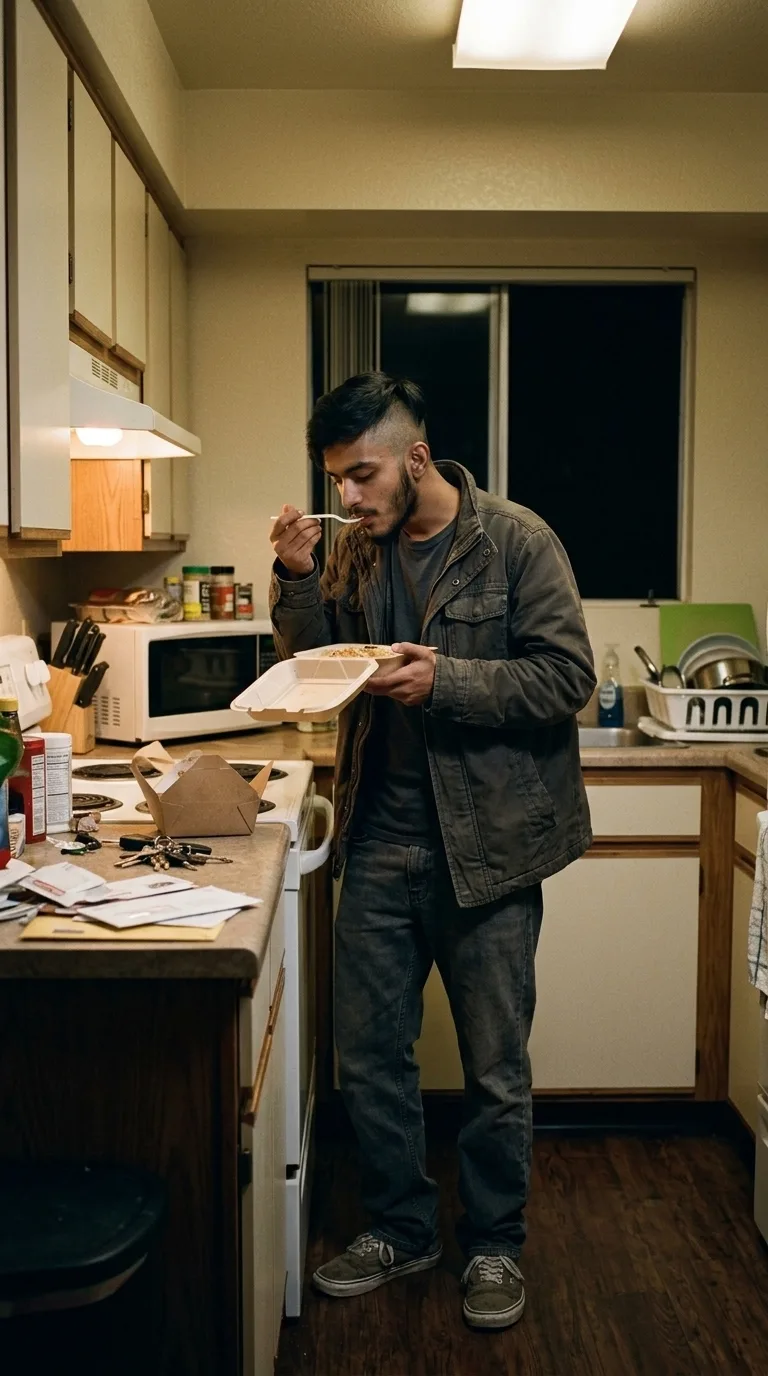
Rarest thing about him: Hindu — common, 1 in 82
Season 1seed 1073558529 · engine v11
Character card
lineage 2NZHHJ
His body-swap story
@connor.waskiewicz, wearing Martin Doyle, rolled the wheel on and woke up as Arjun Mehra, spent under a minute in him, then spun the wheel and woke up as Andre Kimbrough
You are leaving Martin Doyle because of a sentence. Your wife's, in the dark of the hallway, to a daughter who is not yours and is not hers, or is: she said *Daddy's asleep*, softly, the way you say it about a man you are protecting. He had been you for less than a minute and already someone was protecting him. Martin's knees ache on the stairs. His moustache tastes of the tea he drank. You stand in his kitchen, six foot two, athletic, a teacher, and the refrigerator hums at the house of a man who will never wake to find out what happened to him. Nothing is wrong with him. That is the trouble. Something in the hallway sounded like love, and it was addressed to someone else. You press the page, you spin, and the wheel goes round and round.
Fluorescent light, buzzing. The fork is halfway to your mouth and your jaw has already opened for it. Rice, turmeric, hot oil, a green chili you can feel before you taste. The container is warm against your left palm. You are standing, coat on, in a kitchen that is narrow enough to touch both counters. Your feet are in shoes with the laces loosened. Dark window, no stars in it. A body is a weight you inherit all at once: five foot nine, lighter than Martin, a little hollow in the stomach, a long day settled in the lower back and the arches of the feet.
The coat is heavy canvas, worn to softness at the cuffs, and when your thumb slides along the cuff it gives you him. A morning, the hook by a door, a girlfriend's voice from the next room, *you're wearing that again?* and him laughing and not answering, because the coat was his cousin's and still smells faintly of someone else's garage. He is proud of it and ashamed of it in the same breath. Then the keys on the counter: the ring clipped to a belt loop, so many keys for doors that aren't his. School corridor, three in the afternoon heat and then the long quiet after the last bell, when the floor waxer hums and the building exhales. He likes the hour after the children leave. Nobody looks at him in it, and he can think. He mops in long figure eights his uncle taught him. The handle has worn a groove into the heel of his right hand; your hand knows the groove now.
The fork is steel and a little bent. It is his mother's. A flash: a kitchen far from here, a small brass lamp lit before a picture of Ganesh, the smell of ghee, her voice saying *eat sitting down*, and him eating standing up anyway, always, now, in a different city, because sitting at the table alone is louder than the quiet. He does not drink, never did; there is a shame in it for him, a clean one, a vow he keeps for no one watching. Beneath the food, his tongue finds a ridge of dry skin at the lip, and under the beard, thin and patchy, the skin itches. You touch the cleft in your chin without meaning to and it is a landmark he has known since the age of nine, when a boy pointed at it. Money: the envelopes on the counter are bills, a small number, a smaller one. He does the sums at night. Under five thousand dollars is all he has, and he is twenty-two, and he thinks of it as a door he hasn't found yet.
You lower the fork. It touches the counter with a small click.
You look at your hands. Brown, narrow, scarred nowhere, calloused at the palm from the mop. You turn them over. The window gives you back a face with a hard line at the sides of the hair, and a girl's name rises in you that is not yours.
"Well," you say, in a voice with no accent you've ever worn. "Hello."
The rice is going cold. You do not know how long he lasts, or you do, or whether tomorrow you are still here to wonder.