Aniket Suresh Rao
Fictional. Generated by AI — not a real person, and no likeness of one is intended.
41, maintenance technician in Boston · rolled by @connor.waskiewicz · card — no film
History
who has worn him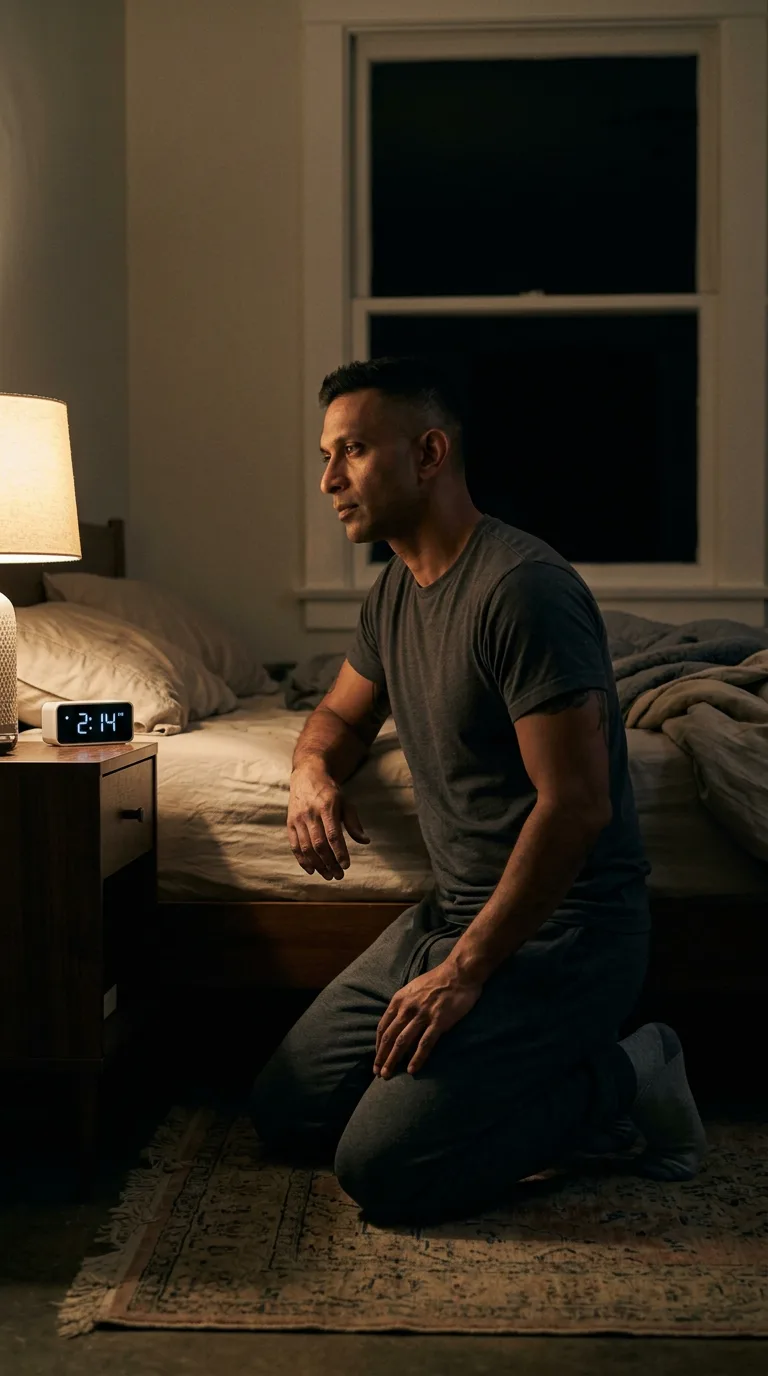
Rarest thing about him: Hindu — common, 1 in 82
Season 1seed 1125468585 · engine v11
Character card
lineage 2NZHHJ
His body-swap story
@connor.waskiewicz, wearing Marcus Adeyemi, rolled the wheel on and woke up as Aniket Suresh Rao, spent under a minute in him, then spun the wheel and woke up as Manuel Osorio
You are six minutes into a body that fit like it was built for you, and already the fit is the problem.
Marcus Adeyemi's kitchen smells like garlic and closing-shift grease, and his phone is still buzzing with a text from a line cook asking about Saturday's schedule, and his hazel eyes in the microwave door's reflection are doing nothing wrong, nothing wrong at all — that is the trouble. Twenty-four, six feet of muscle that never asked for a single one of its workouts, freckles like he was designed by someone with a sense of humor. He is easy. He is a body you could disappear into for a decade and never feel the seams. Which is exactly why the itch starts before the takeout containers are even in the fridge: comfort is the one thing you cannot spin for twice in a row and still call it living. You did not come to the wheel tonight for a better body. You came because a good one, worn six minutes, already felt like a chair you'd been sitting in too long. You open the laptop on his counter — his counter, not yours, none of this was ever yours — and you go to vessel.cards with his hand on the trackpad, and you spin.
You are on your knees on a rug you have never seen, and a bedspread is coming up too close, too fast, and the amen you were about to finish arrives in your mouth half a syllable ahead of you, spoken by nobody, and you rock back up onto your heels on the exhale of it — and then you don't. Your body — his body — folds back down without asking you first, knees meeting the floor again like a marionette settling under its own weight, and the smile that had started on your face, his face, goes out somewhere behind the eyes. Forehead finds the bedspread. Cotton, laundered, a little worn thin at the hem where a thumb keeps finding the same seam.
The thumb. That's the first thing that comes back — not a memory exactly, just a fact arriving with feeling already attached: this thumb rubs this hem when the mind is somewhere else, has done it since the bedspread was new four winters ago, a habit with no name that nobody would ever think to ask about. Then the cotton against your forehead gives you the rest of the shirt, and the shirt gives you the morning it went on: sleeve first, right arm, always right arm first, a small superstition from a mother's voice decades gone — right foot in the door, right arm in the sleeve, luck follows the strong side — and Aniket Suresh Rao has never once questioned it, has done it every day of his adult life without deciding to.
The rug under your knees is thin and old, brought from a mother's apartment after she went into the ground two years ago on a Tuesday he still cannot say out loud without his throat doing something he'd rather it didn't. He prays now the way she prayed, badly, distractedly, more out of a wish to keep the shape of her in the room than any real belief that a ceiling panel and a length of copper pipe leave time for faith. He is good at the ceiling panels. His hands know a compression fitting the way another man's hands know a guitar, thoughtless and sure, forty-one years old and a back that complains on Tuesdays after he's spent Monday on the ladder in 4C. Divorced eleven years — no, never married, that one's a mix-up in the feeling, what actually happened is a woman named Priya who left before there was a ring to leave, and the ache of that has gone soft and small with age, a stone worn round in a pocket. No kids. A brother in Worcester he calls on Sundays and doesn't always pick up for. A cigarette habit he beat eight years ago and still, on hard nights, misses like a friend who moved away.
The clock on the nightstand said something with a two in front of it, the last thing his own eyes read before this. Middle of the night, everyone in the building asleep above and below him, and here he is on his knees anyway, halfway between a shift that ended too late and one that starts too early, praying not very seriously because seriousness was never really the ask — just the wanting to have done it, the way you want to have called your brother back. His leg — this leg, your leg now — is already going, heel bouncing against the rug in a rhythm that started before he could remember starting it, that ran under every dinner table of his childhood and every job interview since. It does not stop for prayer. It did not stop for his mother's funeral either.
You feel all of it land in a body that is shorter than the one you left, harder in a different way — not gym-built, work-built, a compactness that carries a ladder up three flights without thinking about it — and forty-one sits differently in the knees than twenty-four did six minutes ago in a Denver kitchen you have already stopped missing.
You lift your forehead off the bedspread. You look down at your hands, splayed on your knees — his hands, calloused along the pads, a half-moon of grease worn permanently into the crease of one knuckle no soap has ever fully lifted — and you turn them over slowly in the lamp's one small circle of light like you're checking they're the right ones.
"Not tonight," you say, to the empty room, in his voice, and you don't yet know if you mean the prayer or something else entirely — and you lift your eyes up, off your own palm, toward whatever is watching.