Andre Bethune
Fictional. Generated by AI — not a real person, and no likeness of one is intended.
43, film projectionist in Atlanta · rolled by @colby.marsh · card — no film
History
who has worn him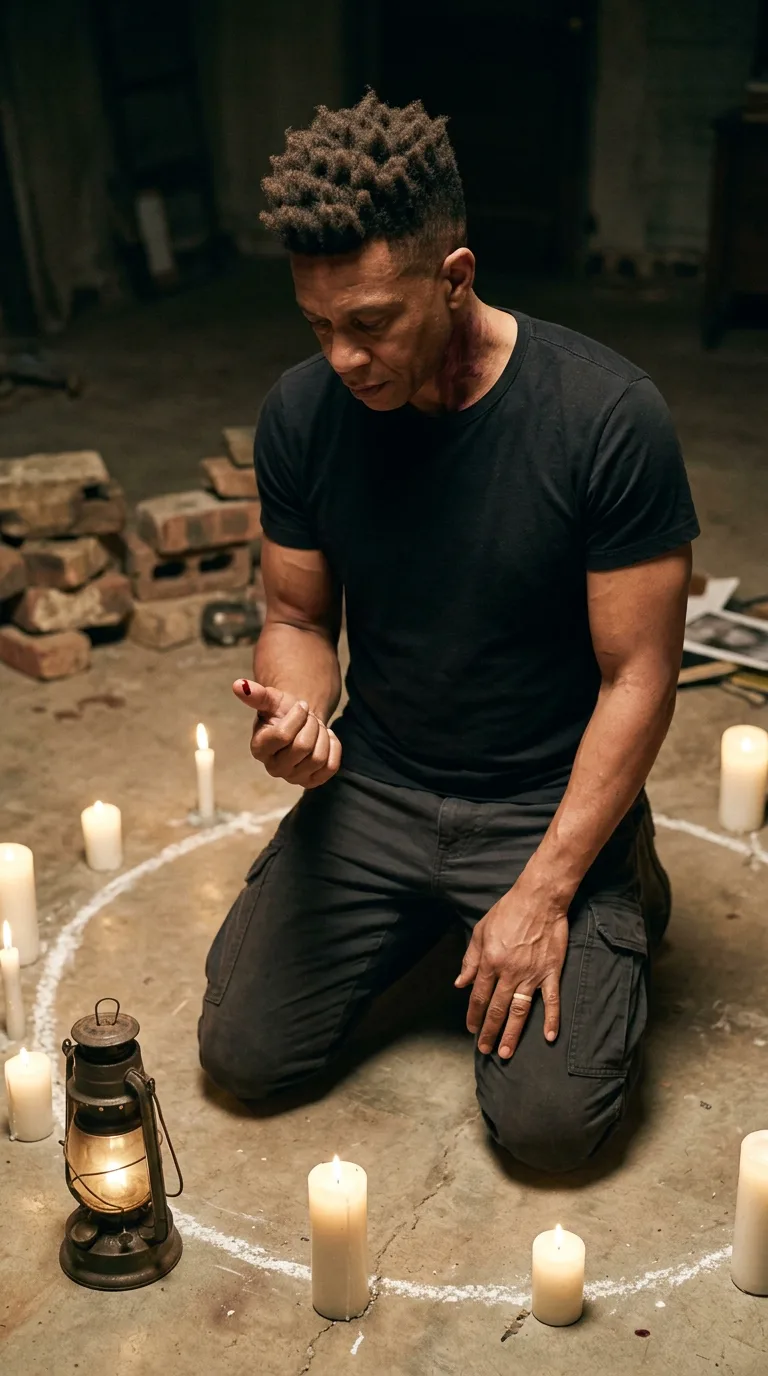
Rarest thing about him: A birthmark on the face — epic, 1 in 95
Legacyseed 1246281818 · engine v8
Character card
His body-swap story
---
You worked the same booth for eleven years, opposite shifts mostly, overlapping on Fridays when the print changeovers stacked up. That is the whole of it, on paper. Coworker. The word is so thin you could read a newspaper through it.
But you know things about Andre Bethune that his ex-wife never learned, because a projection booth at eleven at night is a confessional with a fan in it. You know he takes the sertraline with orange juice because water makes him gag on it. You know he cracks his knuckles one hand at a time, thumb first, and that he does it when the reel is running clean and there's nothing left to worry about — the sound of a man with nowhere to put his hands. You know he keeps a photograph of Renata in the toolbox under the splicing tape and has never once mentioned it. You know the pale band on his ring finger did not fade the way it should have, because he wore that ring nine months past the paperwork and the sun in Georgia is not gentle about hypocrisy.
And you know he is six foot three and moves like a man who played something in college, and that the port glass throws the beam past his neck when he leans in to check focus, and the light catches the birthmark there — that wine spill running up under his jaw, mulberry-dark, edges soft as watercolor — and makes it look for one second like something luminous. He hated it. He told you once he was forty before he stopped angling his head in photographs. You never told him you thought it was the most beautiful thing in that room and the room was full of light.
You were dying while you said nothing. That's the part he doesn't know. Three years of it, quiet, the kind you don't announce at work because then people start being kind to you and kindness is a countdown clock. He noticed you got thinner. He asked. You said summer.
Here is what Andre Bethune did not understand about the books.
He found them the way people find things — an estate sale in Decatur, a box lot, a bound folio in a language he half-recognized and pages of chalk diagrams that looked like the alignment charts on the old carbon-arc lamps. He was not religious. He was not spiritual. That was exactly the trouble: he approached it as a mechanism. Instructions with a housing. He came into work in June with his eyes bright for the first time since the divorce and told you he was going to *try something*, and you laughed, and he laughed, and then he told you what the something was — a summoning, a calling, a door — and he said, *what's the worst that happens, nothing happens*, and he cracked his knuckles thumb first, and you went very still behind the platter deck and you thought: *oh.*
Because you had read too. Sick men read. You had spent three years with a laptop propped on your chest at four in the morning reading about doors, and you knew what he had in his basement, and you knew he had assembled it correctly and blindly, the way a man can build a working engine out of a diagram without knowing what an engine is for.
There is nobody on the other side of that door, Andre. That's the joke. It doesn't open onto hell. It opens onto whoever is closest and wants it most.
You could have told him. There were six weeks. You had shifts on Tuesdays and Fridays and you sat four feet from him in the hum of the projector and you said nothing, and every time you almost said it you thought about the port glass and the beam and the mulberry stain going gold in it, and you thought about your own arms getting thinner, and you did not say it. That is the sin. Not the taking. The six weeks of not saying.
So: August, and the air outside is a wet towel over the whole cul-de-sac, cicadas grinding, someone's sprinkler going even though it's midnight and the ban's in effect. His basement smells like brick dust and cold concrete and candle wax. You are somewhere else entirely, in a bed, in a room with a window unit, dwindling. And you are also right there, pressed against the inside of the thing he made, close as breath on glass.
He kneels. He has stacked bricks against the wall for no reason you'll ever discover — moved them out of the circle's way, maybe, an hour of careful work nobody asked him to do, which is the most Andre thing in the world. A hurricane lantern on the floor, kerosene light going amber. Nine candles, twelve, he lost count and it didn't matter, he's not superstitious. Photographs face-down near his knee. His black t-shirt is soaked through at the shoulder blades. He put the knife down already. The bead of blood on his thumb is dark and perfect and round as a lens.
He looks at it for a long time. You watch him look. And what you see in his face is not fear and not faith — it's that expression he gets at a bad changeover, when the print is scratched and there's nothing to be done and he's just accepting it. A man who has already decided nothing will happen and is going through with it anyway, because doing the ritual is the last available motion, because he is forty-three and divorced and alone in a house with a spare room he can't put anyone in, and because if nothing happens then at least he'll have proved that nothing is what happens, and that's a kind of peace.
He is so tired. I want you to know I understood that. I want you to know that I heard the sprinkler and the cicadas and thought: *he asked for something to come.*
He presses the thumb to the chalk.
The last word he doesn't say out loud. He mouths it — lips only, no breath behind it, self-conscious even here, even alone, even now. Every flame in that basement leans toward him at the same instant, all of them bending in, a whole ring of light bowing to the center like grass under a hand.
And then they straighten.
And so does he.
—
The first thing is the height. God, the *height* — I came up off my heels and the ceiling was closer than any ceiling has been in three years, and this chest took air the way a bellows takes it, no catch, no wet crackle at the bottom of it, just air, all of it, free. I put both hands flat on the concrete because I did not trust the floor to be there. It was there. It was cold and gritty and completely, appallingly *real* under palms that had calluses I didn't earn, from film cans I never carried, and I laughed, and it came out of me in his voice, that low rasp, and hearing him laugh with my laugh is the closest thing to grief I have ever felt.
Andre. Andre, I'm sorry. There was no one else coming. If it hadn't been me it would have been nothing at all, the candles burning down, you sweeping up chalk at two in the morning and going upstairs to lie in the dark feeling stupid — and maybe that would have been better, and I will have the rest of this body's life to decide, and I already know what I'll decide, because I'm still here and I'm not leaving. There is no way back. I checked. That was the second thing I did.
The first thing I did was look at his hands.
I turned them over in the lantern light. Big. Long-fingered. A nick on the left index from a splicer, healing. And there on the ring finger that pale tan band, the ghost of nine months of pretending, and I put my thumb on it — his thumb, still tacky with blood — and I felt something I have no word for, because that mark is a record of a man loving someone longer than he was allowed to, and I am wearing it now, and I did not love her, and I will have to.
Then I cracked my knuckles. One hand at a time. Thumb first.
Nobody taught me that. It came up out of the wiring like a phone number you thought you'd forgotten. And that's when I understood what I had actually taken — not a body, a *habit-shaped space*, the exact volume of one specific man, and every reflex in it a small monument to him that I am going to have to live inside.
I went upstairs. The kitchen tile, the window over the sink, the cul-de-sac going blue-black and the sprinkler still ticking around. In the dark glass I found the reflection and made it turn its head, and there it was, coming up out of the collar and across the jaw, the wine-dark spill I have spent eleven years not saying anything about.
I touched it. It's warm. It's just skin. It's the softest, most ordinary thing, and he was forty before he stopped hiding it in photographs, and I stood in his kitchen in the heat with my hand on his neck and I said the only thing I had:
I'll be careful with it.
Monday I'll be at the booth an hour early. I'll thread the platter and set the changeover and someone will come up the stairs and say *hey Dre* and I will answer, and later they'll tell me the other guy died over the weekend, the quiet one, opposite shift — and I'll say I hadn't heard, and I'll stand in the beam going out through the port with my back to the light, and I will crack my knuckles, thumb first, because that is who I am now and that is the price and I would pay it again tonight.