Alvin Pettigrew
Fictional. Generated by AI — not a real person, and no likeness of one is intended.
64, management consultant in Seattle · rolled by @connor.waskiewicz · card — no film
History
who has worn him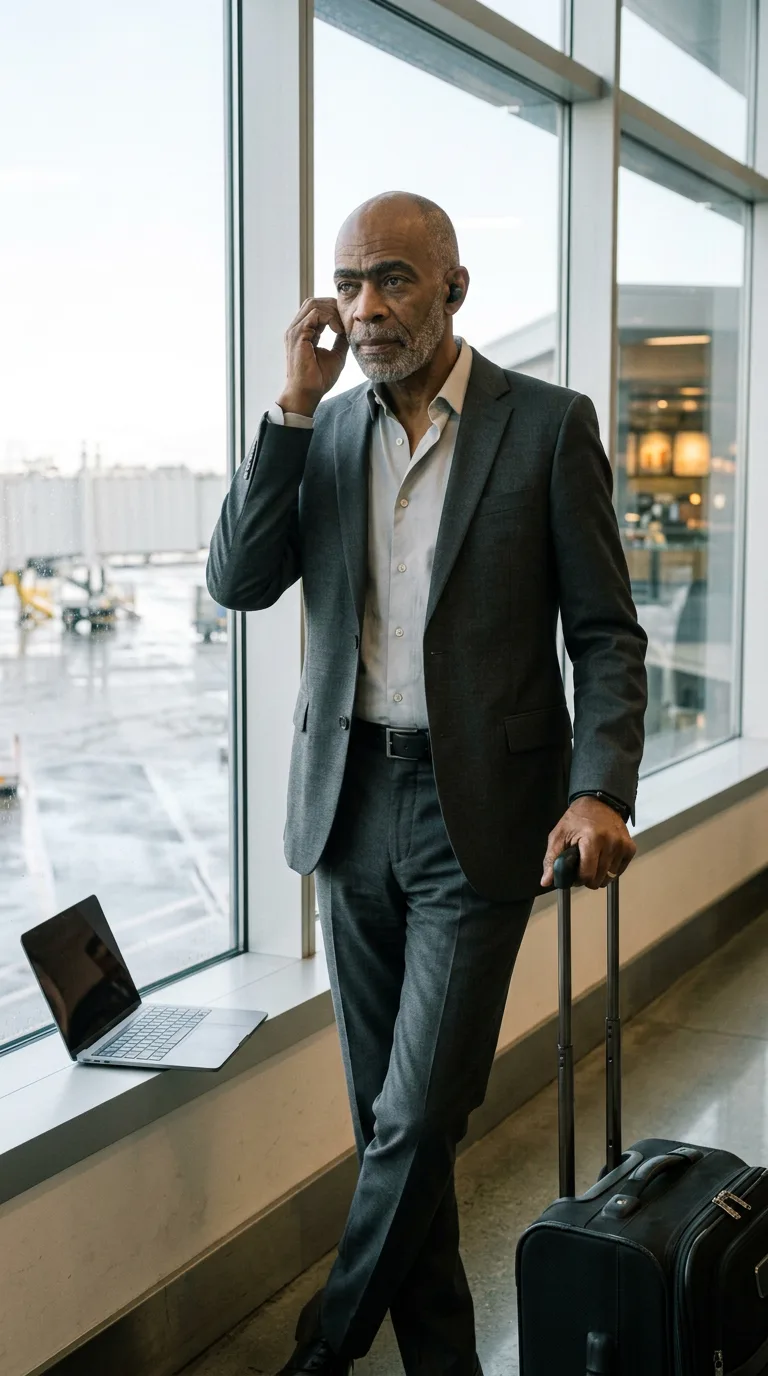
Rarest thing about him: Widowed — common, 1 in 84
Season 1seed 2049422259 · engine v11
Character card
lineage 2NZHHJ
His body-swap story
@connor.waskiewicz, wearing Tony Ferrante, rolled the wheel on and woke up as Alvin Pettigrew, spent under a minute in him, then spun the wheel and woke up as Daniel Whitehorse
You are Tony Ferrante, and you have been him for eight minutes, and already you know what's wrong with him. He is a good body. He is a door you stand in front of with your arms folded, and people look at your arms and decide to be reasonable. Nobody has asked you a hard question all day. At noon in Miami, in the heat off the pavement, a woman looked at you the way people look at furniture that is useful, and you thought: I have been looked at like this before, in forty other doors. The wheel is in your pocket like a coin. You are not unhappy. That is the thing you would not say out loud. You are not unhappy, and you want to be someone who could be.
You spin.
It is a Tuesday morning, gray, rain on the glass, and the apron outside is wet and shining. You are standing at the window with one hand at your ear, the earpiece warm against the bone, the other hand on the handle of a rolling case. Your weight is on one leg, the other crossed over it. Something has just been said in your ear and you were about to answer, the answer is not in you, and the sentence is gone.
You are thin. That is first. After Tony's mass this body is a coat hung on a hook, long and light, all of it at the surface. The knees speak, a low dull note. The back, braced against nothing, is tired in the way of a man who has sat in many narrow seats.
Then the things he touches begin to talk.
The handle under your palm is rubberized and worn smooth at one point, where a thumb has rested for years, and the thumb is yours now, and it remembers a gate in Denver, a delay, his daughter's voice on the phone saying Daddy, it's fine, go to your meeting, and him not going, sitting in a plastic chair with his jacket over his knees until the boarding call. The jacket is on you now. The wool is cool at the shoulders. Sleeve by sleeve it gives you the morning: the left arm first, the hotel mirror, the way he stood sideways to it as he does, checking the line of himself. The shirt buttoned from the bottom up, never the top, because his wife used to do the top one for him, and for three years since he has left it open and told himself it is style. The ring turns when he closes his fist. It is loose now. He has lost weight since the funeral, and the ring has not been resized, because resizing would be a decision.
Your knuckles want to crack. You let them. The sound is small and satisfying, the sound of a nervous boy who became a careful man, and with it comes a church basement, folding chairs, his own father's hand heavy on his shoulder, a hymn he can sing without trying. His faith is not a performance. It sits in him like a beam in a house. You did not expect that, and you do not know where to put it.
The earpiece. A voice still talks in it, a client, patient and wrong, and the man you are wearing has a thousand ways of waiting politely. Under your fingertips the beard is close-clipped and dry, the skin beneath it soft. The unibrow is a thing you can feel when you frown, a weight over the eyes, and a memory arrives of his mother licking her thumb to smooth it flat when he was seven, and of him letting her.
Three children. You feel them as three different weights, the way a man knows his own pockets. The money, too, is a quiet floor beneath his feet, solid and unspoken, earned slowly. A smoker's craving, years dead, flickers once at the back of the throat like a remembered address.
You take the earpiece out. The client goes on, tiny, in your palm.
You look at your hand. Long fingers, the knuckles big, the skin dark and fine-lined, the ring pale against it. You turn it over. The palm is creased and warm and has held everything he has loved, and none of it is yours, and all of it is yours, until the coin turns again.
You look up, and the glass gives you his face back, rain behind it.
"Well," you say, in a voice lower than you expected, a voice with a church in it. "Hello, Alvin."
You do not know how long he lasts. You close the hand, and open it, and wait to find out what you want.