Alvin Pettiford
Fictional. Generated by AI — not a real person, and no likeness of one is intended.
58, factory foreman in Philadelphia · rolled by @jason.tanabe · card — no film
History
who has worn him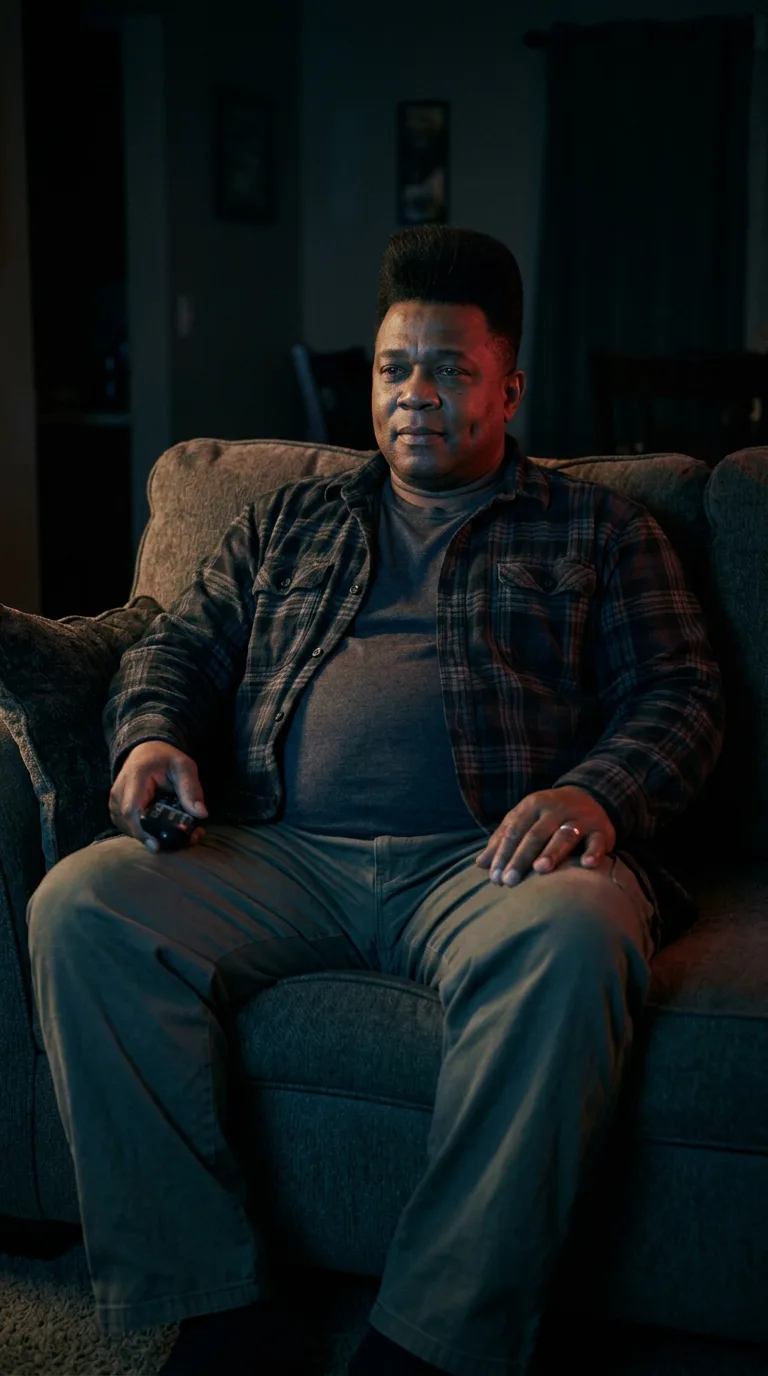
Rarest thing about him: Factory foreman — common, 1 in 175
Season 1seed 1362253520 · engine v11
Character card
lineage Q3AZ7V
His body-swap story
@jason.tanabe, wearing Ramón Estrada, rolled the wheel on and woke up as Alvin Pettiford
You are in Ramón Estrada's cab, parked on a shoulder in Jersey, and your hands are on a wheel that is too far from your chest. Your feet barely reach. Eight minutes of him: the moustache you keep touching, the silver coming in at his temples, the dashboard dull with other people's coffee. The seat has been set for a man with short legs and you cannot stop feeling the pedals as a stretch. His phone buzzes against the cup holder. A daughter's name you do not know. You let it ring out. That is the reason, if you have to say one: it rang and nothing in you moved toward it. You wanted a body that would reach for it. Not this one. You open the page, the wheel is already turning, and Ramón's thumb comes down.
The room is dark and the light is moving. A bright frame fills the television, white, and you are sitting up straight with a remote set down on the couch arm, your hand already open from putting it there. The couch takes your weight in a long sigh. Something is funny on the screen and your face does not know it.
Then the body comes in.
The knee first. The left leg is bouncing, a quick small drumming against nothing, and you cannot stop it. You press a palm to it and the palm is wide and warm and the knee goes on under it. The flannel is soft from washing. Its cuff touches your wrist and you are in a morning: a closet door that sticks, a woman's voice from the bathroom saying not that one, the navy, and his own laugh, easy, his dimples cutting in because he had already known she would say it. Buttons, one at a time, his thick fingers sure of them. Then the undershirt, gray, pulled over a belly he has stopped apologizing to. The ring turns when you flex your hand. It is a little tight at the knuckle, and the memory comes with it: a church basement, folding chairs, his own heart going like the line at work, and her mother crying in the second row.
The couch fabric under your fingers is nubby. Under it, a different afternoon: this couch arriving on a truck, two sons carrying it up the steps while he shouted directions he did not need to shout. Marble steps worn hollow, a rowhouse, first sun coming down the block. The sons are grown now. One calls on Sundays. One does not, and the not-calling sits behind your sternum, heavy, patient, forgiven and not forgotten.
Your back aches low on the left where years of standing on concrete have settled. Your shoulders are enormous and tired. There is a glass on the side table. You lift it and the ice has gone to water, but the rum is there underneath, and the taste brings a whole habit: two, never three, on the couch after the house has gone quiet, the television low so he can hear her upstairs. Under the rum, another woman, long ago, a girl on a stoop in a yellow dress, and a small warm ache that has never hurt anyone.
Your hair is high and stiff under your hand, and you find the shape of it with your palm. He does it every morning, the comb, the mirror, the clean shave, a ritual that is the one vain thing he allows. The memory is of a shirt pocket, a radio, a floor of machines, of shouting names over the line, of being the one they call.
You lift your hands into the screen's light and turn them over. They are broad, dark, scarred by nothing, wearing the plain ring. The knee still bounces. You look up, past the television, into the dark where the room waits, and you say, low, to no one:
"All right. Let's see how long you last."