Alvin Dewayne Truitt
Fictional. Generated by AI — not a real person, and no likeness of one is intended.
57, janitor in Rural Texas · rolled by @caleb.dunham · card — no film
History
who has worn him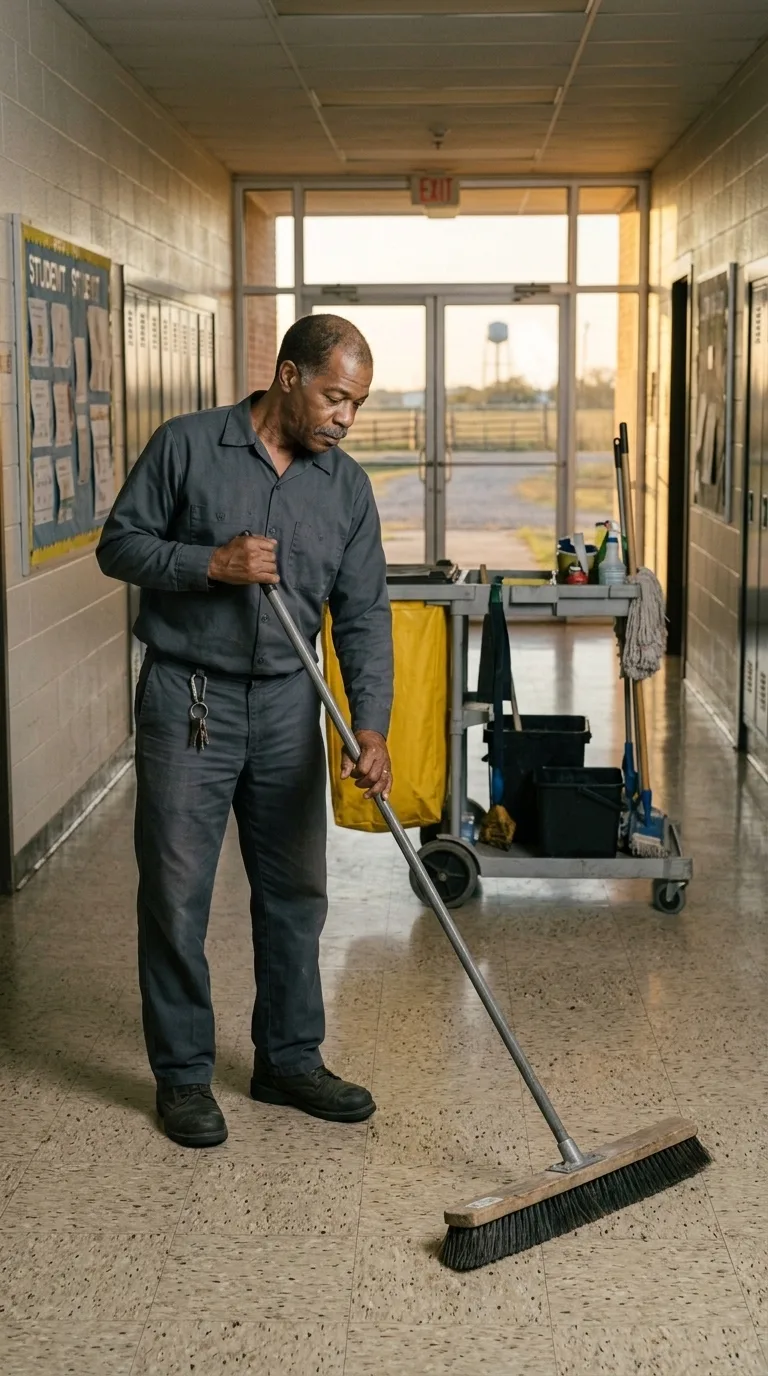
Rarest thing about him: A burn scar — uncommon, 1 in 164
Face-off rating 1500 · not ranked yet
Season 1seed 1377276801 · engine v11
Character card
lineage 9IC4OB
His body-swap story
@caleb.dunham, wearing Lonnie Everett Pickens, rolled the wheel on and woke up as Alvin Dewayne Truitt, spent under a minute in him, then spun the wheel and woke up as Wyatt Boudreaux Fontenot
You are standing in Lonnie Everett Pickens, and his left knee is talking to you. Not the real one. The socket where the prosthetic seats has rubbed a hot coin into the stump since Friday, and you have spent a day and six hours doing his small arithmetic: loosen the strap, tighten the strap, sit, don't sit. You like his goatee. You like the way people in Detroit tell him good morning at the gate of the cemetery grounds. None of that is why.
It is the evening of a Sunday, and the light in his kitchen has gone the color of weak tea. You have just discovered that you cannot stop checking the mailbox for something that will not come. You are bored of being a man who has to be careful. You want to walk down a stair without counting it. You want a body that does not announce itself.
The page is open. The wheel is already turning, with its small dry clicking, and you let Lonnie's thumb come down.
Then a hallway.
The broom is already moving. Your weight is on the right foot, the push-broom handle is warm under both palms, and the stroke you are mid-way through goes wrong, a hitch, a skip of the bristles over the tile. You correct it. Slowly. Right. Then you do the next stroke the same, and the next, checking each one, though a body this old at this work should need no checking at all.
The floor is speckled tile, tan and cream, and the afternoon is coming flat through the glass doors at the end. Beyond them there is gravel, a fence of barbed wire, and a water tower standing on the horizon like a held breath. Nobody is here. The lockers tick as the building cools.
The shirt begins first. Gray cotton, a little stiff, sleeves buttoned at the wrist, and against your shoulder blades it gives you this morning in his hands: a kitchen with the radio low, fingers working the buttons from the bottom up because he has always done it that way, the cuffs last. The collar scratches the scar along his jaw, and it comes with him flinching, years back, a pan, a bright wrongness of grease, his own voice saying it's nothing to someone who did not believe him. His wife. Then she is not his wife, and the pale band on his finger itches under the broom handle, and you feel the particular emptiness of a hand that kept turning a ring that was no longer there.
The keys at his hip swing and chime. Under your thumb their worn brass gives you a door he opens every Sunday, the whole big dark school smelling of floor wax and pencil shavings, and two children's names, a boy's and a girl's, said fondly and carefully, the way you say names you have to say on the phone. He crosses himself at the gym door, every time, out of habit more than faith, and you feel that too. The cigarettes he quit sit in his chest like a shut drawer. His back is stiff at the belt line. His knees are fine. They are fine. You nearly laugh.
You lift your hands from the handle. They are broad, dark, ridged at the knuckle, and cleaner than you expected. You turn them over. Then you look up the long hall into the light and say, quietly, "Well. Let's see how long you last."
Somewhere under the quiet, the wheel is already turning, patient and clicking, and you do not know yet whether this is a Sunday or only a minute.