Alvin Cheatham
Fictional. Generated by AI — not a real person, and no likeness of one is intended.
61, gravedigger in San Francisco · rolled by @everett.dabney · card — no film
History
who has worn him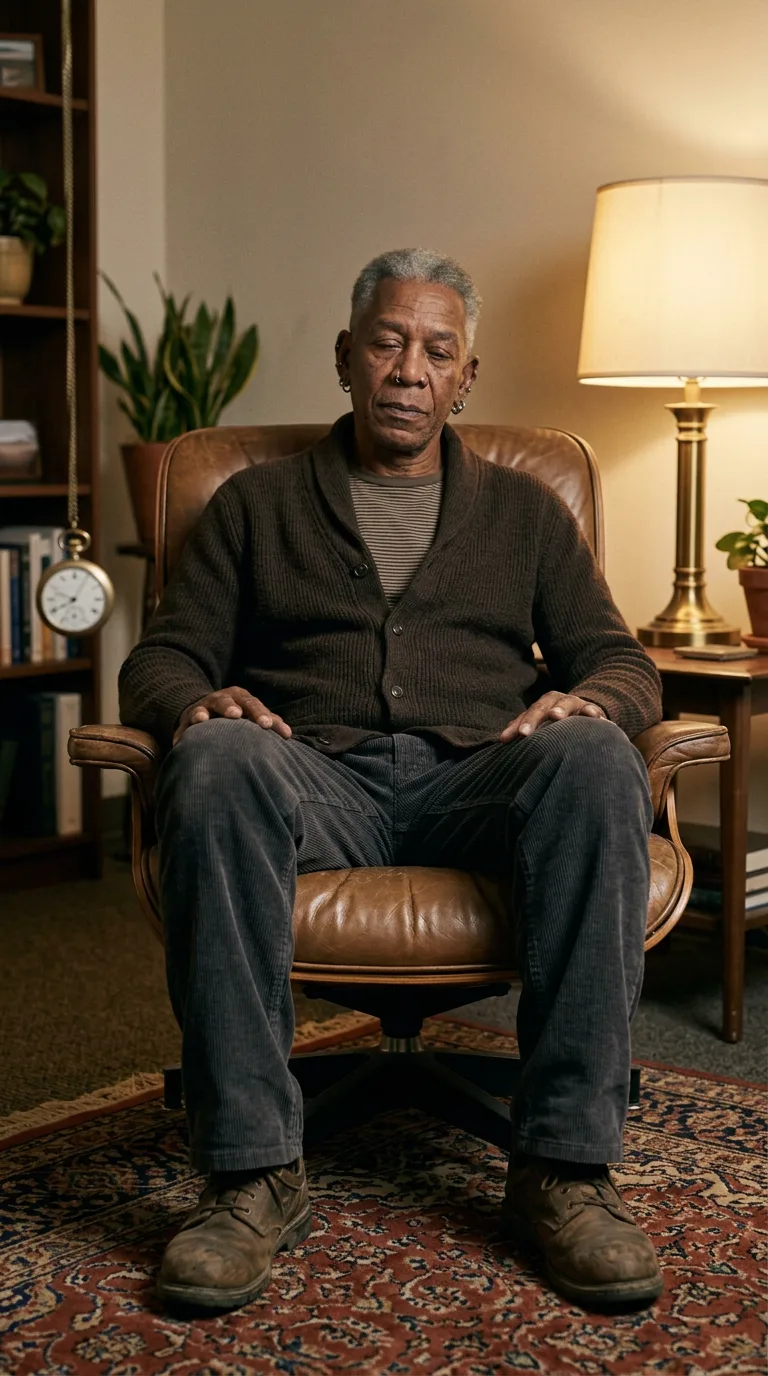
Rarest thing about him: Several — legendary, 1 in 286
Legacyseed 365297736 · engine v8
Character card
His body-swap story
---
You have been nowhere so long that nowhere has a texture. Not dark — dark is something. Just the absence of a next thing. And then a room assembles itself around a voice counting down from ten, and you understand that a door has been left open somewhere and you have been standing at it your whole death.
You don't know him. That's the first thing you want said. Not a father, not a brother, not some man who wronged you in a life you can no longer quite reconstruct. A stranger. Sixty-one years old, sitting in a leather chair with his hands folded like a man in the third pew, waiting to be told what to remember.
The therapist's name is on a diploma you can't read from this angle. Her voice is warm and professionally slow. *You're at the top of the stairs, Alvin. Ten. You feel the banister under your hand.* The pendant watch swings from her fingers at the edge of everything, brass and old, and the tick of it is the only clock in the world.
He is going under so easily. That's what draws you close. Some men fight it, some men come up gasping at eight, but he lets go like a man setting down something he's carried up a hill. Whatever he came here to look at, he wants to look at it. That's a door held open with a foot.
You get to know him on the way down, the way you'd read a man's mail.
Alvin Cheatham. His hands do the talking. There is dirt in them that no soap will finish with — under the nail beds, in the seams of the knuckles, a permanent brown geology. Twenty-nine years at the same cemetery out past the avenues, in the fog belt where the grass never fully dries. He digs graves. He does not say "grounds maintenance," he says what he does. Six by three by six wherever the plot map says, and then the green cloth over the spoil pile so the family doesn't have to look at raw earth while the pastor talks, and then the folding chairs squared up, and then he walks off a discreet distance and stands with his hands crossed in front of him and waits for the last car to go. That waiting — that's most of the job, he'd tell you if you asked. Anybody can dig. The waiting is the trade.
His ears have holes in them from a younger man's decisions and he never let them close; there's a small hoop in each now, and a ring in his nose he put in at fifty-eight for no reason he ever explained to anybody, least of all his daughter, who laughed at him for a week and then said it suited him. Gray-silver hair kept short at the sides, a little left on top, no part, cut by a man named Ferris on Fillmore who charges him what he charged him in 2004.
He lives in a garage. Under-house, below a bay window that belongs to someone else's flat, the driveway cut so steep off the hill that in the rain you go down it braced. Cold white light from a fixture he keeps meaning to warm up with a lamp. There is a hot plate, a bed, a folding table, a Bible with the spine broken at Psalms, a plastic case of insulin needles and a glucose meter, and one photograph pinned to the stud: a woman named Renée at a barbecue in 1993, laughing at something off-frame that was probably him.
That's the ex who still matters. Not the marriage, which was somebody else and brief and neither of them talks about. Renée. She's in Vallejo, and she calls on his birthday and hangs up too fast, and he sits with the phone in his hand after and doesn't turn on the radio for a while. Twelve thousand dollars in the world, roughly, most of it a truck. He drinks maybe three times a year, at funerals of his own people. He quit smoking eleven years ago and still, sometimes, standing at the lip of a hole in the ground at seven in the morning with the fog coming over the wall, his hand goes to a pocket that has had nothing in it since 2013.
And here is what he came to the chair for, which is the thing you learn last and use first.
Six months back he lowered a man he knew. Not a stranger in a box — a man from his church, Deacon Pruitt, who used to put a hand on the back of Alvin's neck and call him *son* even though there were nine years between them. He dug it himself. He wouldn't let the young guy do it. And afterward, standing his discreet distance with his hands crossed, he found he couldn't remember his own father's funeral. Any of it. 1979, and there's a blank where it should be, and he's sixty-one and it's started to seem like a debt. So the doctor at the clinic wrote a referral, and the woman with the warm voice said *we can go looking, gently,* and he said all right.
He wants to go back. He is opening himself as wide as a man can open, and looking away from the door, down the stairs, into 1979.
*Four. Three. You're standing on the last step.*
You come in behind him.
It isn't violence. Nobody's neck breaks. It's more like sitting down in a chair someone just stood up out of — the warmth of another man still in the cushion. The body arrives all at once and in the wrong order. Weight. Enormous weight, the weight of a coat you didn't know you'd been fitted for. Breath, which is a job. A sourness at the back of the tongue and a low grinding thirst that comes with him standard, the diabetes ticking in the blood like a meter running. A stitch in the right shoulder that goes down to the elbow — twenty-nine years of the same motion, the same lift and throw, the same twist at the top. His knees report in from a long way off. His hands are heavy and hot and full of feeling. Callus like leather across the palms. He is a *made* thing, this body; it has been shaped by one action performed a hundred thousand times, and I am wearing it now, and it does not fit me, and it will never not fit me, because there is no way back out of it and no last day on it.
He didn't fight. I want that recorded too. There wasn't time and there wasn't a mechanism. One second he was on the bottom step in 1979 looking for a church he couldn't find, and then he wasn't, and I am not going to tell you where he went because I don't know, and because I came from there and it has no features.
The pendant stops swinging.
Somewhere at the frame edge her fingers come together and a snap goes off like a stick breaking, and the eyes open — my eyes, brown, sixty-one years old, focusing on the middle distance and then, deliberately, on her.
She's waiting for the fog. That's what she's trained for: the slow surfacing, the *where am I,* the man reassembling himself out of the carpet pattern up. What she gets instead is a man looking straight at her, level, awake, present all the way to the back of his skull, a man who was never under for one second of that half hour. I watch her professional warmth catch on something. Her head tilts a quarter inch.
"Alvin?" she says. "How do you feel?"
And I find out that his voice is lower than I expected and comes up out of the chest, and that the throat knows how to say his name and I do not know how to say anything else yet, and so what comes out is: "I'm here."
Which is the only true thing I have.
Then I look down. Both hands on the arms of the leather chair. Brown, thick-knuckled, dirt in the seams that no soap will finish with, a paler line across the base of the fingers where a shovel has been held for twenty-nine years. I turn the right one over. There is his whole life in that palm and none of it is mine and all of it is mine now, for good, unto the end, and the first thing I am going to have to do with it is drive a truck down a steep driveway in the fog and unlock a garage door and stand under a cold white light in a room where a woman named Renée is laughing at something off-frame, and be him, and never once be him.
I lift my eyes off the hand and into her face.
Tomorrow there's a grave to open out past the avenues. Somebody's mother. Six by three by six, and the green cloth over the spoil, and the chairs squared up, and then that discreet distance with the hands crossed, waiting.
I know how to wait. It's the one thing I brought with me.