Alonso Cardenas
Fictional. Generated by AI — not a real person, and no likeness of one is intended.
37, logger in Nashville · rolled by @colby.marsh · card — no film
History
who has worn him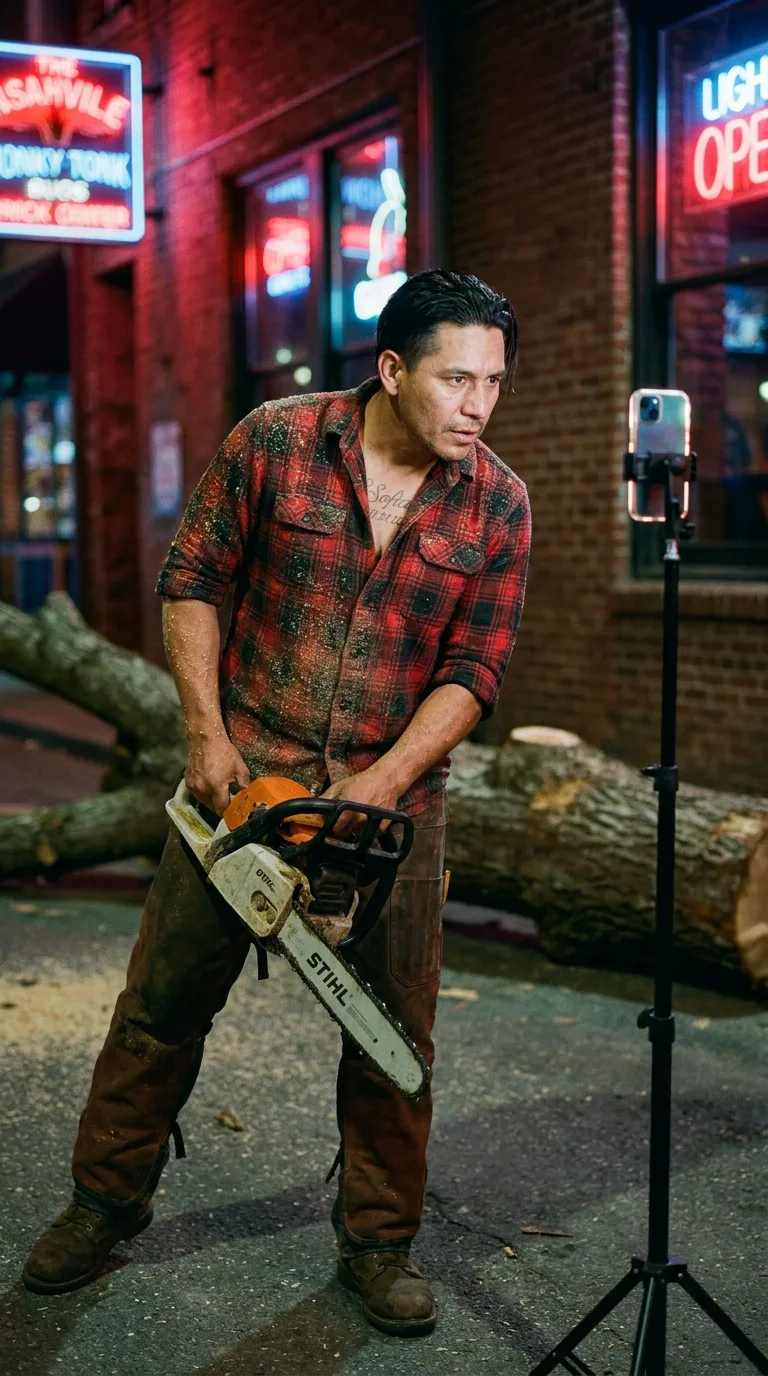
Rarest thing about him: Flips a lighter — rare, 1 in 51
Legacyseed 662785595 · engine v7
Character card
His body-swap story
---
You have watched him for eleven nights and he has never once known it.
That is not remarkable. Nobody knows. A stream is a window with the light on inside it, and the man in the lit room assumes the dark outside is empty because he cannot see into it. You have been the dark outside for a long time. Long enough to have preferences. Long enough to be picky, which is a thing you never expected of yourself, back when you were only wanting and had no way to reach.
His channel has two hundred and nineteen followers, most of them men who also cut trees. He goes live from the block at seven in the morning, phone jammed into a clamp on a stump, the light off the snowmelt so flat and grey it makes his face look like a photograph of a face. He explains things. That's the whole show. Where the hinge goes. Why you never stand in the escape path you cut. The way a red oak talks before it goes over — a low popping in the fibers, like knuckles — and how if you hear that and you're still thinking about your lunch, that's the last thought you get.
He says that sort of thing kindly. That is the part you kept coming back for. He says *that's the last thought you get* the way a man says it who has personally decided not to be the one it happens to, and who would prefer it not happen to you either, stranger, whoever you are out there in the two hundred and nineteen.
Alonso Cardenas. Thirty-seven. Five foot nine and built like the work: forearms out of the rolled flannel, chest tattoo showing at the open collar in script — *Sofia*, and a date, and you have watched that name go in and out of the light with every breath he takes for eleven nights and you still do not know if Sofia is the wife or the daughter. You never asked. You are not in the chat. You are only in the dark.
Nothing to his name. Under five thousand dollars, and most of that is a truck. Two kids. A wife whose voice you have heard exactly once, off-camera in a kitchen, saying *Alonso, the eggs*, and he said *un momento, mi amor* without looking up and kept explaining wedges to two hundred and nineteen men. Catholic. There's a chain under the shirt sometimes. He crosses himself before he pulls the cord on the saw, quick, barely a gesture, thumb to forehead and gone — and you noticed on night four that he does it every single time and has never mentioned it and probably does not know he does it.
He drinks when other people are drinking. He does not smoke and never did, which makes the lighter strange: an old brass one, dented, and when he is between cuts and talking he flips it, over and under across his knuckles, over and under, and it goes on in the corner of the frame like a metronome under everything he says. Eleven nights of that sound. You could pick it out of a crowd.
You want it. Not the lighter. All of it.
---
The gig was somebody's idea of Nashville. A big silver maple came down across the alley behind the honky-tonks in a storm and the city was going to get to it in a week and the bar owners could not wait a week, so Alonso got called at nine at night for cash and drove in with the saw in the bed. He set the phone up on the stand because the light was ridiculous — neon bleeding red and blue off wet brick, OPEN sign buzzing over his shoulder, a whole broken tree lying in a strip of asphalt between two bars where a tree had absolutely no business being.
*Y'all are not gonna believe where I'm at,* he said, and laughed, and the chat woke up.
He worked for forty minutes. Bucking rounds off the trunk, and every time the saw cut out the sound of a steel guitar came through the wall behind him, some woman singing about a man who left, and Alonso would stand up in that and grin at nothing and go again. Sawdust in his hair. Sawdust on the plaid. Fifty-one people watching. He read comments out between cuts, holding the saw down at his knee like a dog on a short leash.
*Hoss says use the felling dogs. Hoss, there's no felling dogs on a maple in an alley, man, come on.*
*Yeah, that's a Stihl. Yeah, she's old.*
And then he leaned in.
You watched him do it — the lean. He does it every time there's something in the chat he has to squint at, tips his weight forward over the saw, one side of his face going bright in the phone's glow and the other going out entirely, and his mouth moves before the words come, because he reads with his lips a little and has never noticed that either.
You had put a line in the chat. Your first, in eleven nights.
You will not tell anyone what it said. It was not a threat and it was not a spell and it was not clever. It was just true — a small true thing about him that nobody else out there in the two hundred and nineteen had any way of knowing, and reading it he stopped, and the sawdust settled off his shoulder, and he lifted his eyes off the text to the little black circle above it. Not at the audience. Not performing. Looking, the way you look at a person who has said something to you in a dark room.
And you are the room. And you have been looking back for eleven nights.
There is no crossing. There is only that he looked, and the looking went both ways, and you were already through — the way water is already through the second the seal fails, no journey to it, just before and after.
*Before* is his weight on the balls of his feet and the saw hot against his leg and a chorus coming through brick and his wife's name on his chest going in and out with his breath.
*After* is yours.
---
The head goes back. That is not something you do; it's the body doing what a body does when the man who has been driving it since 1988 is not there anymore, and it takes half a second to find out that somebody is. Light comes out — out of the eyes, out of the open mouth, white and hard, up into the neon like the alley has caught something it can't hold — and it fills the phone's little frame and blows the exposure white and fifty-one people are going to argue about codecs for a week.
Then it's out. And you're slack in him. Standing there loose with a running saw in your hands and a body full of somebody else's whole day: the ache across the lower back, the burn in the right shoulder, the wet in the left boot, forty minutes of vibration still humming in the palms. The salt taste. The two beers, hours ago, at somebody's house. His heart going at the rate a man's heart goes after forty minutes of bucking maple.
You had not thought about the noise. The saw is still going and it's *in* you now, all the way up the arms into the teeth, and you find the trigger with a finger that already knows where the trigger is and let it die. It dies down through octaves and stops. The steel guitar comes back through the wall. That woman still singing about the man who left.
You set the saw down on the asphalt. That takes some doing — you have to bend, and bending is a whole negotiation with a spine you've never used, and you go down further than you need to and put it flat and it clatters. Sawdust falls off you when you stand.
The chest is what you notice. Not the tattoo — the chest itself, the fact of it, the way the breath moves the whole front of you and the ribs go out and the cold air off the wet brick comes in and it is *warm in here*, it is so much warmer in here than you remembered anything being, and there's a chain against your sternum you can feel now, a thin cold line lying across the *S* of a name you still do not know the owner of.
Then the hands.
They came up on their own. That's the thing you'll think about later, when there's a later, when there's twenty years of later: that the hands came up without being asked, into the phone light, palms then backs, the way a man checks himself for blood. Wide across the knuckles. Nicked. Sawdust in the creases and a rind of pitch on the right thumb. Callus like shoe leather at the base of every finger, and under it a pulse you can feel in the fingertips because it is going hard.
A plain gold band on the left. Worn to nothing on the inside. Thirty-seven years of another man's grip built into these fingers and you have all of it — the way they'll fall onto a saw handle, the way they'll find the trigger, the way they will absolutely know how to hold a child you have never met, because that is in the meat and the meat came with the house.
Something in the right hand wants to move. You let it. The brass lighter is in the shirt pocket and the hand goes and gets it and it starts flipping, over and under across the knuckles, metronome, easy, eleven nights of that sound and now it is coming from you.
You did not know how to do that. You still don't. He does.
That's when you look up.
Fifty-one people. Phone on its stand, screen live and glowing, and in the little rectangle a man in a red plaid shirt standing in a neon alley with a tree at his back and his own hand held up in front of him. His face. His mouth. Brown eyes with the blue sign burning in them.
You have him for good. There is no term on it and no road back and you knew that going in, the way you know a door only opens the one way, and standing there you feel the whole size of it arrive: the wife, the eggs, the two kids, the truck, the four thousand dollars, the Mass on Sunday, the thumb to the forehead before the cord, the name on the chest you will have to be able to say out loud within the hour like you've said it ten thousand times. All of it, forever, and none of it yours, and all of it yours now.
You lean toward the lens. It's the lean. You do it the way he does it, because these are his shoulders and they only know the one way.
And because fifty-one people are waiting, and because a stranger is a thing you can only be until somebody speaks, you say the only true sentence you have:
*"I'm alright. I'm just — I gotta get home."*
---
Nobody clipped it right. The ones who saved it saved the flash, because the flash is the part that looks like something. They argue about the sensor and the neon and whether he'd put the phone too close to the OPEN sign.
Not one of them saved the hand.