Aiden Marsh
Fictional. Generated by AI — not a real person, and no likeness of one is intended.
23, Hindu priest in San Francisco · rolled by @colin.hasbrook · card — no film
History
who has worn him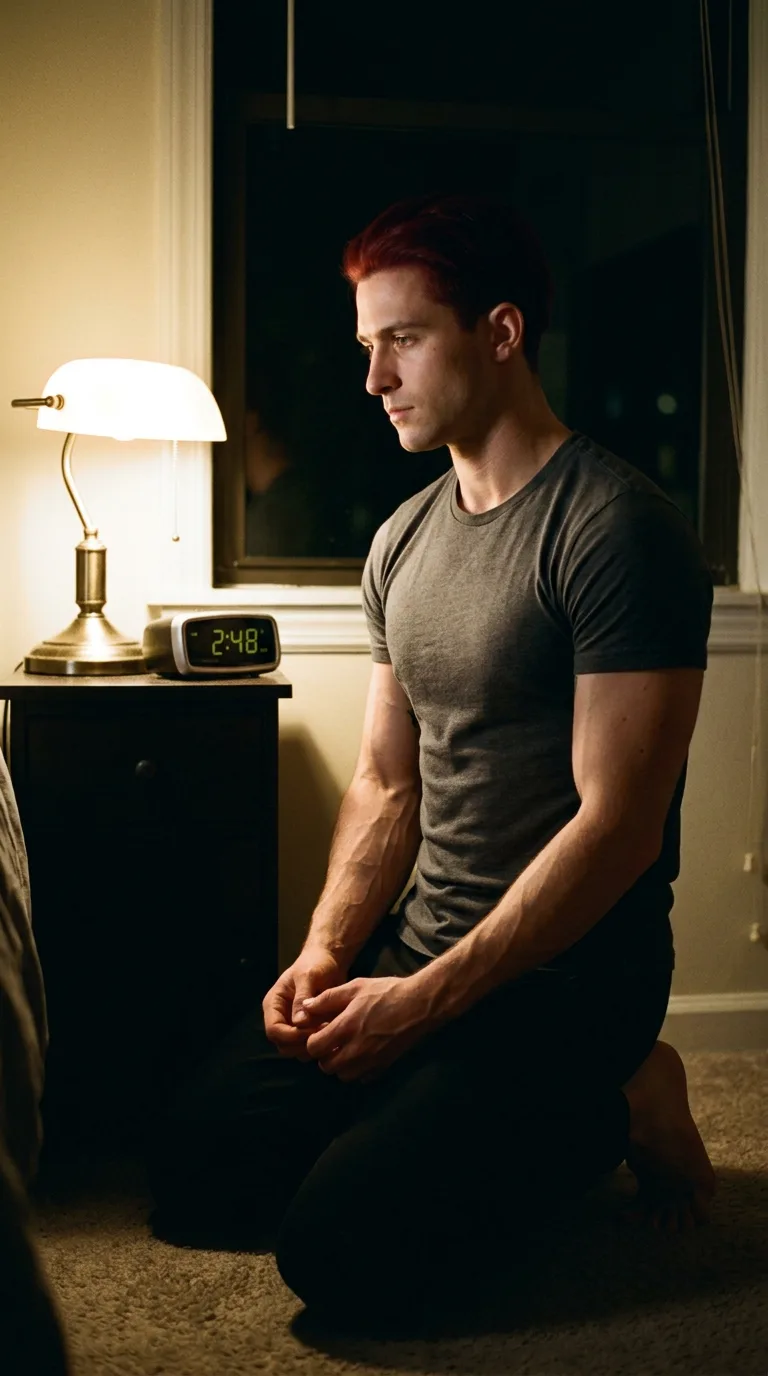
Rarest thing about him: Dyed red — uncommon, 1 in 154
Season 1seed 366289078 · engine v11
Character card
lineage 2NZHHJ
His body-swap story
@colin.hasbrook, wearing Perry Adelmann, rolled the wheel on and woke up as Aiden Marsh, spent 3 minutes in him, then spun the wheel and woke up as Sunil Bhagat
—
You are standing at a chain-link fence in Pittsburgh, before the sun, in a body that isn't tired because it never sleeps properly anymore. Perry Adelmann's body. Six-one, skinny in the way men get skinny when they stop cooking for themselves, a scar cutting through the eyebrow that some other stranger's fist put there decades before you arrived in him. You have had him less than a day, and already you know what he is: a man watching a parking lot for eight-fifty an hour, waiting for something to happen so he can radio it in and feel, for one minute, necessary. Nothing happens. It never happens. His flashlight is dead in his hand and his knees ache going down the stairs and there is a woman he left a voicemail for last night that she will not return, and you know all of this the way you know all of them eventually — not because you care, but because it comes through the uniform, the belt, the radio clipped at his hip, whether you want it or not. You did not spin again because Perry is unbearable. You spun again because he is fine, and fine has a way of going quiet on you, and the quiet is the thing you have never once been able to sit in. You take out your phone in the guard booth at ten to five and you open the site, and the wheel is already spinning before you've decided anything, the way it always is.
—
The floor comes up first — not concrete, carpet, cheap and deep enough to hold a knee-print — and then the light, low and amber from a lamp with a brass shade, and then your hands, which are not Perry's hands, folded loosely in front of you like you were about to let them go. You were saying something. Amen, maybe, said too soon, said light, the corner of a smile still living in the muscle of your — his — cheek when the floor rises to meet your forehead and the smile goes out like someone found the switch.
—
The bedspread against your forehead smells like fabric softener and, underneath that, like the little brass oil lamp two rooms over — ghee, wick-smoke, a smell that isn't in this room but is on his hands, in the creases of them, permanent now the way turmeric stains permanent. That's the first thing that comes: not a memory so much as a fact of him, this body doesn't fully wash off the temple, hasn't in three years, since the day the head priest at the mandir on Vasco pressed a diya into these very hands and said do this like you mean it even on the days you don't. He didn't mean it tonight. Kneeling at the edge of the bed at an hour that should be dawn and is instead the dead flat middle of the night — because he is off tonight, off in the small ruined hours after a closing shift he picked up to cover Anand's kid's recital, and prayer at 2:48 a.m. is what a tired man does out of habit more than belief, going through the motions because the motions are easier than deciding not to.
The t-shirt against your back gives you the morning it went on — not this morning, some morning, all its mornings folded into one: pulling it over his head in the studio apartment under the bay window, the ceiling low enough near the walls that he ducks without thinking anymore, sun coming sideways through the one high pane at driveway level so the whole room goes white and cold before nine. He chose this shirt because it was on top of the basket, not because it meant anything, and that carelessness is its own small memory — a man who irons the dhoti for work and cannot be bothered to fold his own laundry, and finds this funny, has told Priya this is funny, has watched her not laugh at it the exact way that means she thinks it's a little sad.
Priya. The name arrives with a warmth that surprises you, coming up through the mattress under your knees — this bed, her weight sometimes in it, the specific ache of missing someone who is only in Fremont, forty minutes and a bridge away, missing her on a night she isn't even due to be here. And behind Priya, colder, a name that arrives through the pillow instead of the bed, through a scent long since laundered out but remembered anyway — Sonia, six months gone, the ex whose absence he still measures other absences against, whose voice he can still do in his head doing the thing she used to do, calling him too devout for a man who forgets to eat.
Your arm — his arm — carries its own small shame against the sleeve: the tattoo up near the shoulder, blurred at the edges the way cheap ink gets, done on a dare in a friend's kitchen at twenty, some kanji neither of them could actually read, and he flinches from it in every mirror, tugs sleeves down over it at the temple without being asked, has never once told his mother. The dip tin lives in the nightstand drawer eight inches from your knee and its shape comes back through nothing but proximity — the packing motion of it against his palm, the low hum of a habit he picked up post-college and never quite dropped even after quitting drinking cleanly, easily, almost without noticing.
And under all of it, the drum of his own fingers, restless even in prayer, tapping once against his thigh before he catches himself and stills them — a tell nobody in his life has ever pointed out to him, a body that does not know how to be perfectly quiet even when it's asking to be forgiven for something it can't quite name. Twenty-three years old, strong through the shoulders from lifting the same heavy brass and hauling flower garlands and prostrating on hard marble floors five days a week, a body that knows devotion as a physical act before it knows it as a feeling — and none of that devotion was fully in the room tonight. He got to the amen early. He was already half up, weight coming onto the balls of his feet, mind already on the drive to Fremont he might make before sunrise just to surprise her — when something in him sat back down instead, and he never got to finish deciding why.
—
You lift your face off the bedspread and look at the hand still curled near your knee — his hand, red-nailed at the cuticle from turmeric he can never quite scrub out, a stranger's hand until about four seconds ago — and you turn it over slowly in the lamp light like you're checking it's real.
"Sorry," you say to the empty room, to no one, in his voice, "wrong prayer."